Structure & Governance
Legal Structure &
Organizational History
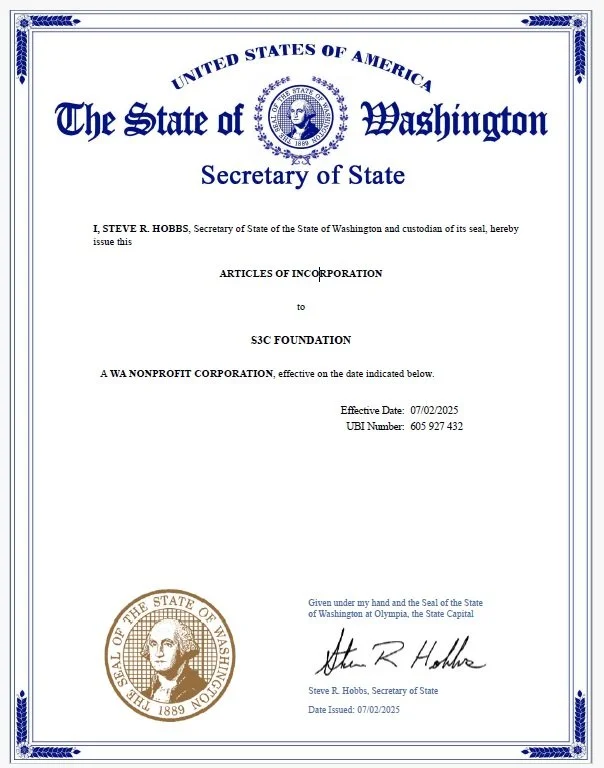
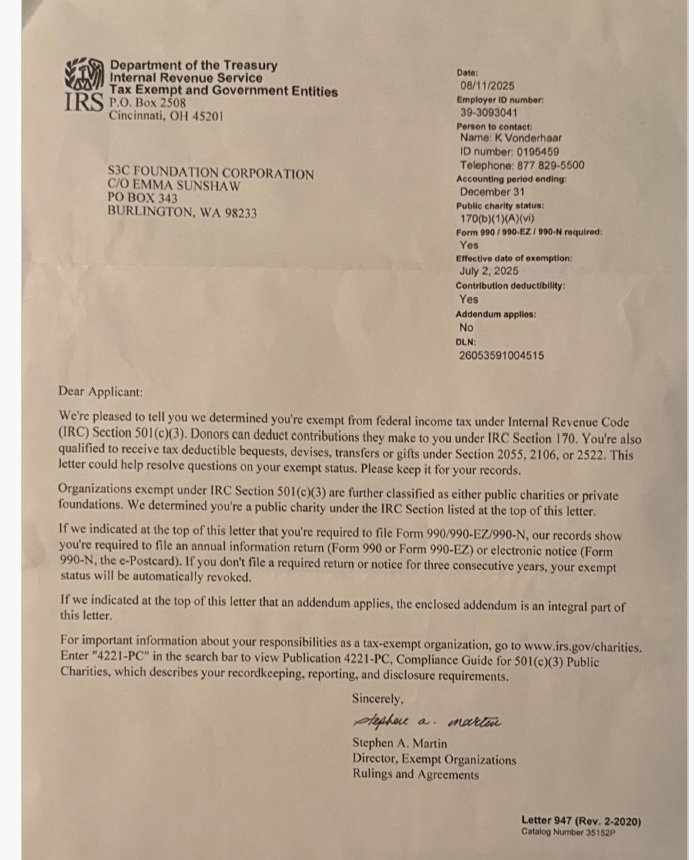
S3C Foundation (DBA System Speak) is a registered nonprofit corporation
in the State of Washington and operates as a 501(c)(3) tax-exempt
organization under federal law.
Introduction & History
How did S3C Foundation come to be? What experiences has Emma Sunshaw had to prepare for this? You know who Emma is, and you know our mission, and you have learned about what we are doing, but how did we get the experience for this work to become a nonprofit? It’s been a long journey!
While the only active nonprofit is S3C Foundation, Emma’s experience was gained through participation in previous efforts and through voluntarily serving in other organizations throughout her career.
Over the years, several registrations were filed by Emma in different states during periods of transition, relocation, and restructuring through life experiences and attempts to support those who were falling in the gaps of available support. Some of these filings were under her maiden (Emily Thomas), married (Emily Christensen), or current legal name of Emma Sunshaw, depending on timing. Emma legally changed her name as part of leaving a high-demand, high-control environment and consolidating nearly fifteen years of work under the longstanding project of System Speak, and she embraced this as part of honoring her own healing.
For clarity and transparency, we provide a history of Emma’s experience and learning curve below. Unless explicitly noted, Emma received no income from the entities listed below; they were exploratory or volunteer, and several efforts never became operational nonprofits. Further, unless explicitly noted, these efforts or organizations were unrelated to System Speak or S3C Foundation, beyond being preparatory in skill and experience.
TRAINING
1. Emma Sunshaw’s fifteen years of experience serving on local nonprofit boards during her PhD studies and during her career. This included rape crisis centers and organizations supporting marginalized communities. These roles also included work with national and international trauma-focused nonprofits. This background has informed S3C Foundation’s development, but the Foundation is an independent organization with its own governance and policies. Emma received no income from these endeavors, as all were volunteer, excepting the part-time staff with ISSTD in the Professional Training Program, which she did in exchange for being able to attend professional conferences.
2. Seven Lively Arts (Oklahoma, 2016) - Seven Lively Arts was a nonprofit founded by Nathan Christensen (co-parent with Emma Sunshaw) through his local theater community. Its purpose was to fundraise for specialized medical equipment for foster children. One child was selected by a community physical therapist, and a fundraising event was held. Although the event itself operated at a financial loss, the community enjoyed the event as a success, and Nathan and Emma ensured the child received the specialized walker needed. Following a family relocation due to medical needs, the organization was not continued.
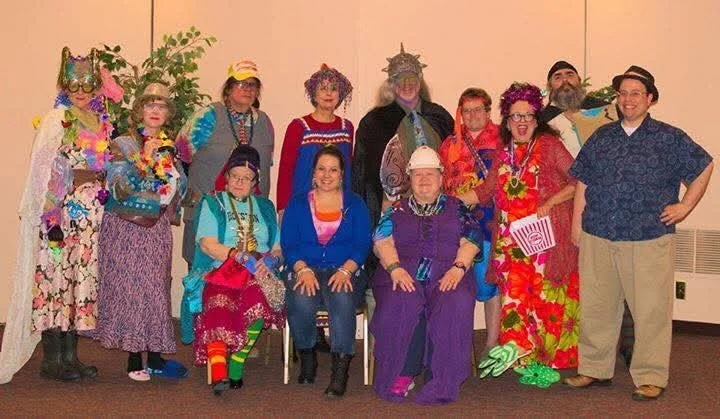
3. Kyrie’s Kids (Oklahoma, 2017) - Kyrie’s Kids was an exploratory nonprofit concept intended to support foster infants on hospice so that they would not experience isolation at end of life. Emma had been working as a chaplain in the NICU at the time of her own foster child being born with medical complications, and she was seeking a way to offer comfort and care to other children. At the same time the concept was being developed, Oklahoma legislation redefined group home classifications. Due to those regulatory changes, the project could not move forward and was not operationalized.
EXPERIENCE
4. Initial System Speak Filing (Oklahoma, 2023) - An early registration for the System Speak nonprofit was filed in Oklahoma during a period when the founders maintained a public PO Box in that state and had safety concerns related to doxxing. No nonprofit was established under that filing. The organization was instead filed in the new state of residence (Idaho).
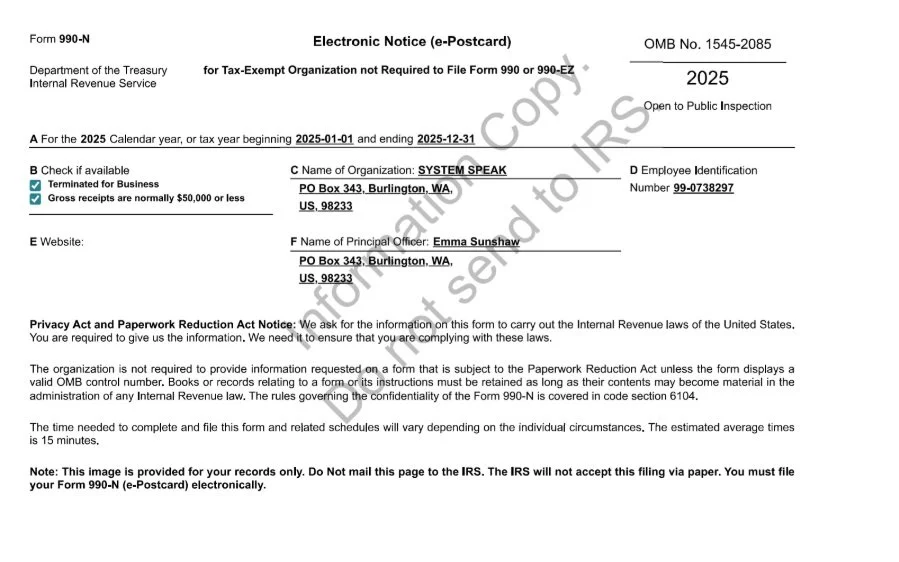
5. Original System Speak 501c3, as established in Idaho in 2024, and closed shortly thereafter in March 2025 following the 2024 election due to administrative and regulatory changes that followed.
Following the 2024 election, there were major federal executive actions and regulatory shifts, and the National Council of Nonprofits released statements underscoring concern about actions they see as disruptive to the nonprofit sector’s ability to serve communities. In January 2025 they responded to federal executive orders, asserting that such actions could “threaten to unwind decades of progress” and impact the work of charitable nonprofits nationwide. They said they would “continue to closely monitor all executive, administrative, and congressional actions that impact nonprofit organizations” and act to support the sector.
In February 2025, the National Council of Nonprofits issued another statement intensifying their response to escalating concerns in response to the actions of the federal administration.
In response, the System Speak nonprofit moved to close in the state of Idaho and reorganize with increased safety and support, which happened only four months later, in a state (Washington) with more nonprofit support for the health and sustainability of the organization (see below).
This original System Speak nonprofit was formally dissolved in accordance with state and federal procedures. The Board voted in March 2025 to dissolve the organization following safety and administrative considerations. All required state filings were completed in June 2025 in accordance with Idaho’s quarterly reporting schedule. Final IRS notification was completed in February 2026 when the annual filing portal opened, in advance of the applicable deadline (not due until May 2026). All dissolution steps and all tax filings were completed in compliance with state and federal requirements.
6. Second System Speak Filing (Oklahoma, 2025) - During the reorganization, a filing was again initiated in Oklahoma before determining that registration must occur in the state of residence and the founders were moving to Washington rather than back to Oklahoma. No nonprofit was established under that filing.
RELOCATION
S3C Foundation is a diverse organization. Our directors, our staff, and a substantial share of the community we serve are LGBTQ+2S, a variety of ethnicities, and many are also survivors of religious and institutional trauma. State law materially affects those people: it determines access to healthcare, the legal recognition of families, and the degree of protection available when harassment occurs. Where we are incorporated is therefore a safety decision as much as an administrative one.
Prior to the founders' relocation from Idaho to Washington, the Idaho organization was dissolved and the work was reorganized in Washington. Washington's statutory environment offers greater protection for the people who govern, staff, and participate in our programs, and the state also maintains a stronger support infrastructure for small nonprofits. Both mattered. State law also requires a nonprofit corporation to register in its state of residence, so relocation made re-registration necessary regardless.
This decision was made during a period of significant change in the federal regulatory environment for charitable organizations. As mentioned above, the National Council of Nonprofits issued statements in January and February 2025 raising concerns about the sector's capacity to serve communities under new federal directives. That context informed our timing. The decision itself was about where our people would be safest.
ESTABLISHMENT
This current organization: S3C Foundation (Washington, 2025) - S3C Foundation (DBA System Speak) is the current and only active nonprofit organization. The story of its name is shared HERE, and even after re-organization, we needed it to be clearly distinct from the original organization that had closed, as well as identifying System Speak as only one of our projects in development. S3C Foundation is registered in Washington State and operates in compliance with state and federal requirements. All tax, quarterly, and annual filings are current. You can see current organizational financials HERE.
Separation of Nonprofit and Private Practice
Because the Foundation is not yet funded at a level that allows Emma Sunshaw or others to work at the nonprofit full-time, Emma Sunshaw still maintains a separate, for-profit private psychotherapy practice.
The nonprofit and the private practice are legally and operationally distinct.
These organizations maintain:
Separate EINs
Separate bank accounts
Separate bookkeeping systems
Separate annual reports
Separate articles of incorporation
Separate websites and branding
Separate event management and financial records
S3C Foundation does not provide psychotherapy services. The System Speak website and the S3C Foundation website both clearly state that no clinical services are provided in those settings and that Emma Sunshaw is not acting in the role of therapist in nonprofit or podcast activities or events. This statement is also included in the podcast show notes for each episode.
Role Clarity and Professional Boundaries
S3C Foundation provides psychoeducational programming and community-based consultation. It does not provide psychotherapy services.
Emma Sunshaw serves in distinct professional roles:
Licensed psychotherapist in private practice
Founder and educator within S3C Foundation
These roles are legally and operationally separate.
Dissociative disorders and complex trauma are highly specialized areas of care. In many regions, there are few clinicians, educators, or community resources available for individuals living with dissociative experiences. As a result, individuals sometimes independently seek out educational or peer-based programming in addition to their clinical care.
S3C Foundation recognizes both the ethical responsibility to maintain clear professional boundaries and the ethical responsibility not to unnecessarily restrict access to appropriate support.
Professional ethical codes recognize this balance.
The American Counseling Association (ACA) Code of Ethics (2014) and the National Association of Social Workers (NASW) Code of Ethics (2021) both address dual relationships and multiple roles. These codes do not prohibit all role overlap. Rather, they require clinicians to:
Avoid exploitation or harm
Maintain clear professional boundaries
Document role clarity
Protect client welfare
Take steps to minimize potential conflicts of interest
In addition, the APA Ethical Principles of Psychologists and Code of Conduct (2017) and related professional standards emphasize avoiding harm (Principle A: Beneficence and Nonmaleficence), maintaining integrity (Principle C), and managing multiple relationships when unavoidable in a manner that protects clients.
In specialized trauma fields, some overlap between educational spaces and clinical populations may occur simply because of the scarcity of services. Excluding clients from educational programming solely because they are also therapy clients may, in some cases, limit access to needed support. Ethical decision-making therefore requires careful boundary management rather than automatic exclusion.
When a therapy client independently chooses to participate in S3C Foundation programming:
The psychoeducational nature of the space is clarified.
Emma Sunshaw is not functioning as a therapist in that setting.
No therapeutic services are provided in nonprofit spaces.
Clinical issues are referred back to scheduled therapy sessions and secure clinical communication channels.
Emergency concerns are directed to appropriate emergency services.
Boundaries are reviewed explicitly for clarity.
At in-person events, professional boundaries are stated explicitly, including clarification that Emma participates solely in an instructional role. This is stated directly, explicitly, and publicly at each event.
The programming is psychoeducational and community-based consultation, not clinical treatment.
To preserve these professional boundaries and prevent role confusion, Emma does not participate in socializing during events where overlapping roles may exist.
Participation in nonprofit programming does not create additional therapeutic services, alter treatment plans, or change access to clinical communication channels.
If therapeutic issues arise related to event participation, those matters are addressed during scheduled therapy sessions, through the secure professional client portal, and/or under the same structure and boundaries that apply to all participants. Emergency needs are directed to appropriate emergency services in the same manner as any other circumstance.
Further, no new clients are accepted or recruited from any S3C Foundation events or programming. If Emma Sunshaw is approached from someone involved in System Speak activities for therapeutic services, that person is redirected to the lived experience recommendation list of therapists organized by geography, which they can search themselves. A link to a directory of ISSTD therapists may also be provided, which they can search themselves.
These practices are consistent with professional ethical guidance regarding dual relationships in small or specialized communities, such as in rural areas or the Deaf community, etc. The goal is to protect client welfare while ensuring that individuals living with dissociation are not excluded from scarce educational and community-based resources.
These measures are designed to balance two ethical commitments:
Preserving professional boundaries and preventing dual-role harm.
Ensuring that individuals living with dissociation are not excluded from scarce educational and community resources simply because of the limited availability of specialized services.
The Foundation remains committed to transparency, role clarity, and responsible stewardship of both clinical and community spaces.