Many survivors, peer group members, and clinicians listen to Huberman Lab, the podcast hosted by Dr. Andrew Huberman, a professor of neurobiology and ophthalmology at Stanford School of Medicine (Huberman, 2026). Because his recommendations reach so many people, including people living with complex trauma and dissociation, the S3C Foundation is sharing its perspective on what in his content is helpful, what is overstated, and what can cause harm for the people we serve.
What We Affirm
We recognize the value of popular neuroscience in making trauma easier to talk about. His trauma episodes bring the science of trauma to millions of listeners who may never open a clinical text. Guest conversations on the podcast have described dissociation as a childhood defense when a child can neither fight nor flee, noted that dissociation and hypervigilance in children are often misread as ADHD or inattention (Huberman, n.d.-a), and explored how shame can trap survivors in cycles of hypervigilance and self-criticism (Huberman, 2026). His attention to breath, light, and sleep also fits well with body-based regulation, which can complement necessary relational trauma therapy.
Our Concerns
Stabilization must come before trauma processing. In his episode on fear and trauma, Huberman says that a detailed recounting of traumatic events is essential for exposure-based and cognitive therapies to work (Huberman, n.d.-b). That reflects mainstream PTSD treatment. We understand PTSD to be incident-based, whereas we consider complex trauma and dissociative disorders to be relational and attachment wounds requiring a different kind of care.
For complex trauma and dissociative disorders, treatment guidelines call for phase-oriented care in which safety, stabilization, and symptom reduction come first, and trauma processing follows when the person has the capacity for it (International Society for the Study of Trauma and Dissociation [ISSTD], 2011). A survivor with DID or OSDD who pushes into traumatic memories without internal cooperation and external support can face destabilization, increased switching, and crisis.
For people with complex trauma histories, this can be life-threatening.
Dissociation is left out. His trauma content centers on fear circuitry and PTSD. Again, it is important to differentiate PTSD from CPTSD, and to remember PTSD is incident-based. Something happened, and it is over (post-traumatic), with lingering impact such as dysregulation or distress because of what already happened.
CPTSD is chronic, relational, and ongoing. These are attachment wounds of trauma and deprivation. The wound is different, the disorientation is different, and the treatment is different.
Dissociation does appear in guest episodes, yet it rarely shapes the tools he recommends. Survivors who do not see themselves in a fear-extinction model may conclude that the tools fail because they themselves are failing. A framework that leaves people with that conclusion is ableist.
Confidence outpaces evidence. Critics, including immunologist Andrea Love, argue that the podcast often presents preliminary findings as practical protocols and ranges well beyond his area of expertise (Love, 2024). We are particularly concerned about sponsored supplements. Academic credentials lend authority to product claims the research does not support, and the FDA is not authorized to approve dietary supplements for safety and effectiveness before they are marketed (U.S. Food and Drug Administration, 2022). For survivors who are searching for relief, sometimes on limited budgets and alongside psychiatric medications, this combination of authority and marketing creates financial and medical risk.
Optimization can echo abuse. Optimization language runs throughout the podcast: master your state, take control of your biology, override fatigue and fear. For survivors of coercive control and organized abuse, healing framed as self-mastery can echo the demands of the abuse environment: perform, comply, and ignore the body's signals. The message to "fix yourself" can be retraumatizing at best and life-threatening at worst.
Colonization and Appropriation
Several of the practices that made the podcast famous come from Indigenous, South Asian, and other non-Western healing traditions. Huberman coined the term "non-sleep deep rest" as a Westerner-friendly name for yoga nidra, a practice rooted in Indian yogic tradition, so that listeners wary of its spiritual associations would try it (Summer, 2026). The practice keeps its benefits while the tradition loses its name, its teachers, and its context. When knowledge carried for generations becomes credible only after a Western scientist renames it, that hierarchy of knowledge repeats one of the working mechanisms of colonization.
The podcast has also featured long conversations about psilocybin, ayahuasca, and other psychedelics, centered on their biology and clinical trial uses (Huberman, 2021). Indigenous leaders have raised concerns about the appropriation of these medicines, disregard for their sacred standing, exclusion from research and practice, patenting, and exploitative tourism, and have proposed eight ethical principles to guide this work (Celidwen et al., 2023). We share those concerns. For people with dissociative disorders, unregulated retreats bring added risk through altered states, unclear consent, and unfamiliar facilitators.
Decolonizing scholarship places colonial, historical, and intergenerational wounds at the center of healing (Linklater, 2014; Mullan, 2023). Protocols aimed at an individual body rarely address those histories, communities, and systems.
Honest attribution and survivor choice support each other: we can name a tradition and credit its teachers while letting each survivor choose whether to engage a practice in secular or spiritual terms.
Separating Substance from Trend
Measured against the research, his most popular recommendations fall into three groups.
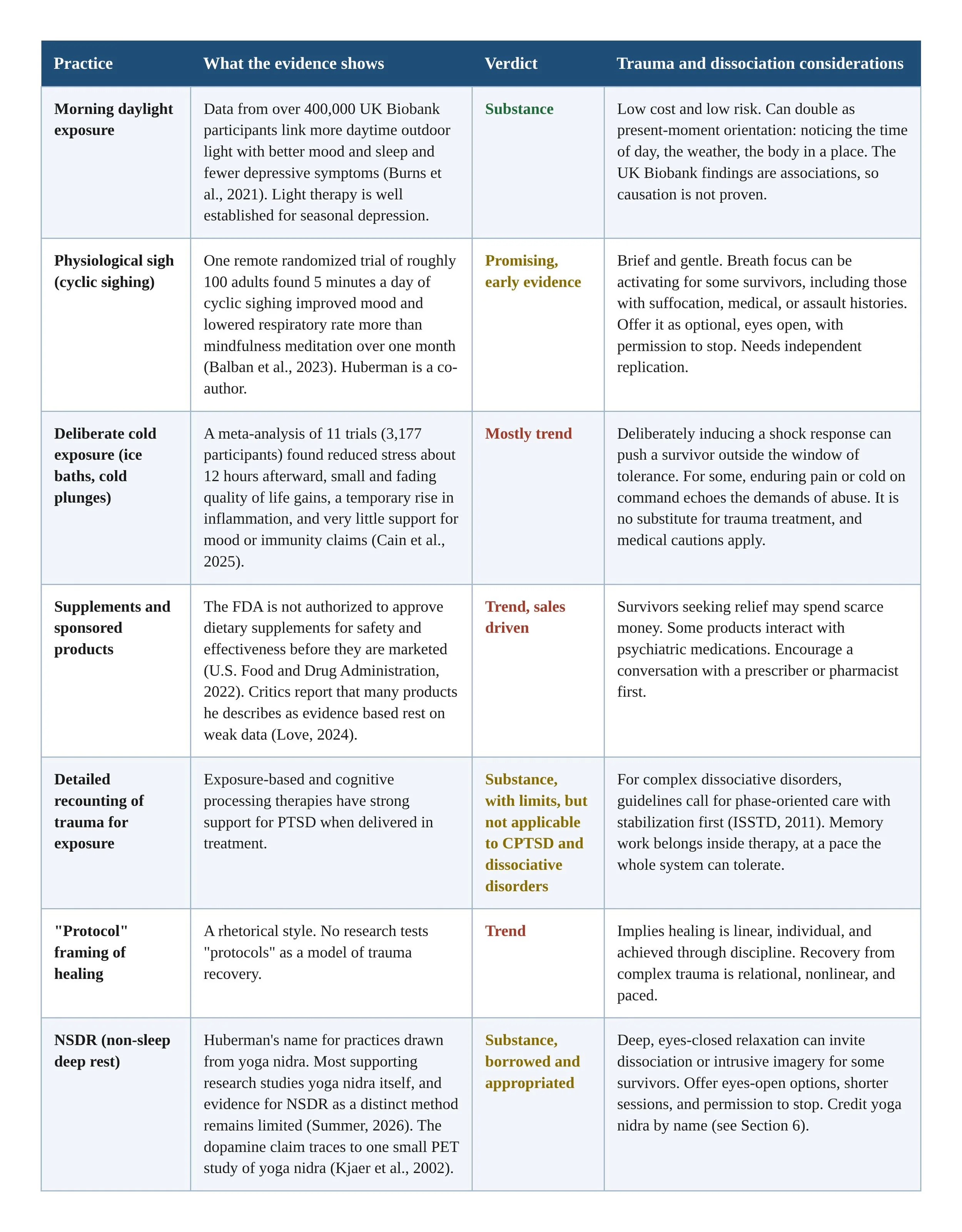
Substance. Morning daylight is associated with better mood and sleep and fewer depressive symptoms in more than 400,000 UK Biobank participants (Burns et al., 2021). Deep relaxation practices drawn from yoga nidra also have research support, nearly all of it on yoga nidra itself (Summer, 2026).
Promising but early. Cyclic sighing improved mood more than mindfulness meditation in one month-long randomized trial co-authored by Huberman (Balban et al., 2023). It needs independent replication.
Trend. Cold plunges reduce stress for about 12 hours, with little support for claims about mood or immunity (Cain et al., 2025). Supplement stacks and the "protocol" framing of healing belong here as well.
The tools with real substance tend to be simple, free, and old.
The trendier elements tend to be dramatic or sold.
Even the helpful tools need adaptation for survivors: breath focus can be activating, eyes-closed relaxation can invite dissociation or intrusive imagery, and deliberately inducing a shock response can push someone outside the window of tolerance.
Our Commitments
We name practices by their origins and credit the traditions and teachers behind them.
When we offer practices from a living tradition, we invite and compensate teachers from within that tradition where possible.
We do not endorse psychedelic use outside regulated clinical settings, and we support Indigenous-led ethical principles for this work.
We include historical, collective, and intergenerational trauma in our psychoeducation alongside individual neurobiology.
We offer every practice as optional and adaptable, in secular or spiritual terms, as each survivor chooses.
Guidance for Survivors
Treat podcast content as general education, and check it against your own treatment plan and your therapist's guidance.
Stabilization comes first, and returning to safety is ongoing. If an episode or tool encourages going into traumatic memories, bring it to therapy before trying it alone.
If parts of your system object to a practice, treat that response as useful information.
Talk with a prescriber or pharmacist before starting supplements, especially alongside psychiatric medications.
Look for dissociation-informed resources to fill in what mainstream wellness content leaves out.
Our Position
The S3C Foundation recognizes the value of popular neuroscience in making trauma easier to talk about. Some of Dr. Huberman's simplest recommendations, such as daylight exposure and slow, exhale-focused breathing, have reasonable support and can be adapted for survivors. At the same time, his content underrepresents dissociation, at times presents early findings with more confidence than the evidence allows, and promotes products and protocols whose popularity exceeds their evidence. For people living with complex dissociative disorders, the central principle remains: safety and stabilization come before trauma processing, and healing happens best in relationship, at a pace the whole system can tolerate. S3C also calls for honest attribution of practices drawn from Indigenous and South Asian traditions, and for respect toward the communities that have carried them.
S3C Foundation
Emma Sunshaw, PhD, Executive Director
References
Balban, M. Y., Neri, E., Kogon, M. M., Weed, L., Nouriani, B., Jo, B., Holl, G., Zeitzer, J. M., Spiegel, D., & Huberman, A. D. (2023). Brief structured respiration practices enhance mood and reduce physiological arousal. Cell Reports Medicine, 4(1), Article 100895. https://doi.org/10.1016/j.xcrm.2022.100895
Burns, A. C., Saxena, R., Vetter, C., Phillips, A. J. K., Lane, J. M., & Cain, S. W. (2021). Time spent in outdoor light is associated with mood, sleep, and circadian rhythm-related outcomes: A cross-sectional and longitudinal study in over 400,000 UK Biobank participants. Journal of Affective Disorders, 295, 347-352. https://doi.org/10.1016/j.jad.2021.08.056
Cain, T., Brinsley, J., Bennett, H., Nelson, M., Maher, C., & Singh, B. (2025). Effects of cold-water immersion on health and wellbeing: A systematic review and meta-analysis. PLOS ONE, 20(1), Article e0317615. https://doi.org/10.1371/journal.pone.0317615
Celidwen, Y., Redvers, N., Githaiga, C., Calambás, J., Añaños, K., Chindoy, M. E., Vitale, R., Rojas, J. N., Mondragón, D., Rosalío, Y. V., & Sacbajá, A. (2023). Ethical principles of traditional Indigenous medicine to guide western psychedelic research and practice. The Lancet Regional Health - Americas, 18, Article 100410. https://doi.org/10.1016/j.lana.2022.100410
Huberman, A. (Host). (n.d.-a). Dr. Victor Carrión: How to heal from post-traumatic stress disorder (PTSD) [Audio podcast episode]. In Huberman Lab. Scicomm Media. https://www.hubermanlab.com/episode/dr-victor-carrion-how-to-heal-from-post-traumatic-stress-disorder
Huberman, A. (Host). (n.d.-b). Essentials: Erasing fears and traumas using modern neuroscience [Audio podcast episode]. In Huberman Lab. Scicomm Media. https://www.hubermanlab.com/episode/essentials-erasing-fears-traumas-using-modern-neuroscience
Huberman, A. (Host). (2021, September 20). Dr. Matthew Johnson: Psychedelic medicine [Audio podcast episode]. In Huberman Lab. Scicomm Media. https://www.hubermanlab.com/episode/dr-matthew-johnson-psychedelic-medicine
Huberman, A. (Host). (2026, January 22). Essentials: Therapy, treating trauma and other life challenges with Dr. Paul Conti [Audio podcast episode]. In Huberman Lab. Scicomm Media. https://www.hubermanlab.com/episode/essentials-therapy-treating-trauma-and-other-life-challenges-paul-conti
International Society for the Study of Trauma and Dissociation. (2011). Guidelines for treating dissociative identity disorder in adults, third revision. Journal of Trauma & Dissociation, 12(2), 115-187. https://doi.org/10.1080/15299732.2011.537247
Linklater, R. (2014). Decolonizing trauma work: Indigenous stories and strategies. Fernwood Publishing.
Love, A. (2024, March 27). Scientists like me knew there was something amiss with Andrew Huberman's wildly popular podcast. Slate. https://slate.com/technology/2024/03/andrew-huberman-huberman-lab-health-advice-podcast-debunk.html
Mullan, J. (2023). Decolonizing therapy: Oppression, historical trauma, and politicizing your practice. W. W. Norton & Company.
Summer, J. V. (2026, October 13). Non-sleep deep rest (NSDR). Sleep Foundation. https://www.sleepfoundation.org/meditation-for-sleep/what-is-non-sleep-deep-rest
U.S. Food and Drug Administration. (2022, October 21). Information for consumers on using dietary supplements. https://www.fda.gov/food/dietary-supplements/information-consumers-using-dietary-supplements